Start here
Puppets in Italian: worth it?
Whether the Syracuse pupi show works if you speak no Italian: what happens on stage, the English backstage visit, holding a puppet, children and the catches.
Find a puppet show date ↗Quick answer
Yes, for most visitors. The Opera dei Pupi is told in Italian only, but it is a theatre of action as much as words: armoured wooden knights duel, battles move fast, music drives the scenes and the odd dragon bursts in. The English comes in the guided visit behind the stage, where the workings are explained and you can try holding a puppet. The whole visit lasts roughly ninety minutes and works for children. Read up on the paladins first and you will follow far more.
The visit in one table
| This ticket | |
|---|---|
| Length | About 1.5 hours |
| Show language | Italian only |
| Backstage guide | English or Italian |
| Hold a puppet | Yes, backstage |
| Under-twos | Free entry |
| Food and drink | Not included |
| Showtimes | Vary by season |
| Free to cancel | Up to a day ahead |
Short verdict: who should go
Go if you are curious about a Sicilian art on UNESCO's intangible heritage list, and you are happy to let action carry you where words cannot. It suits families, anyone who likes theatre in any language, and travellers who want an evening that belongs to this island rather than to any city. Think twice if you need every line explained to enjoy a play, or if you were hoping for a meal with your show. The language is no secret: the performance is given in Italian only.
What you actually watch
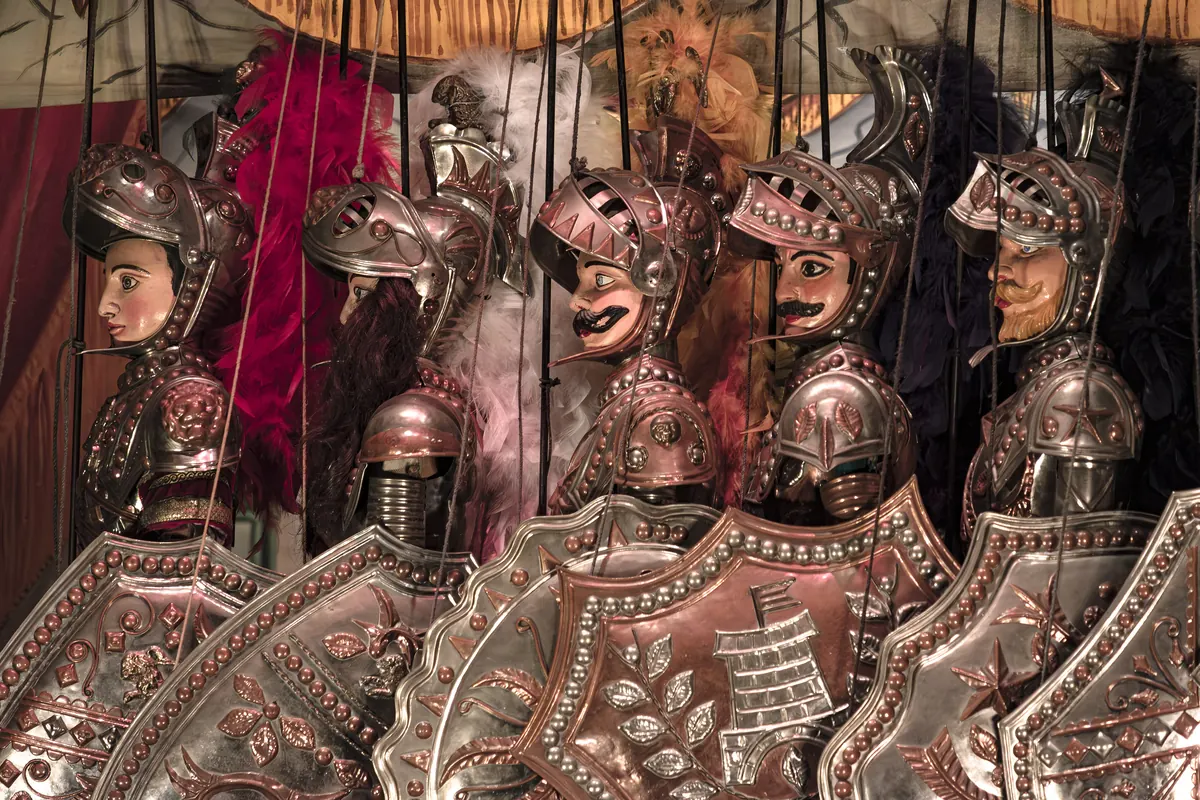
The pupi are marionettes with wooden bodies, worked by rods and wires from above, and the warriors among them wear real metal armour, chased and decorated. The stories come from the Carolingian cycle: Charlemagne, his paladins and their Saracen enemies, as the Song of Roland and Orlando furioso tell them. In practice that means duels and battle scenes at speed, music underneath, high drama, and creatures such as dragons and alligators that turn up in the plot. Which episode you see is the theatre's choice, and it changes. The battle scenes are where the art shows best: the handlers make the clash of swords and shields into something close to choreography.
Why the Italian matters less than you fear
Pupi theatre grew up with audiences who came back evening after evening, and much of its meaning sits in what you can see. Christian knights are carved with kind, symmetrical faces and carry their family emblems on helmet, breastplate and shield, so the audience could tell them apart at a glance. Saracens have sharper features, trousers and turbans, with half moons and stars on their armour. The fights are staged as a kind of rising, rhythmic dance. Even with no Italian, you can tell who is good, who is the enemy, and who is winning.
The part in English: behind the stage
The ticket includes a guided visit behind the stage, and the guide speaks English as well as Italian. This is where your questions get answered: how the puppets are built and moved, how the handlers work out of sight, and why the tradition matters to Sicily. It is also the moment to ask anything the show left you wondering about, from who that crowned figure was to how the armour is made. Look for the main iron rod, which passes through the head into the torso and carries the strings for the limbs, with a hook at the top so a puppet can hang ready. Then you can try holding one yourself.
How heavy is a paladin?
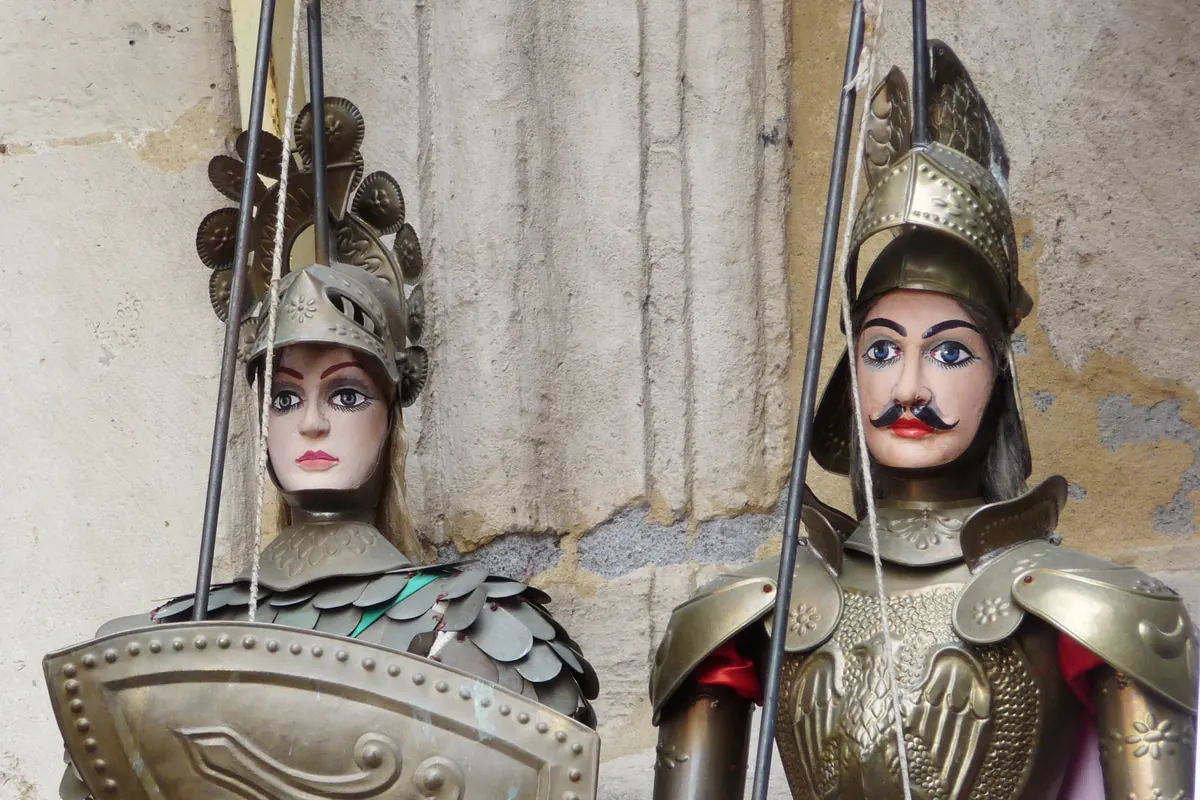
Sicily has two main schools of pupi, and they are built differently. The Catania style, used across eastern Sicily including Syracuse, has padded frames and stiff legs; its puppets usually stand 110 to 130 cm tall and can weigh about 30 kilos. Palermo's are smaller, around 90 cm and 5 to 10 kilos, with jointed knees. English Wikipedia describes the puppets of Syracuse's historic theatres as close to the Catania type in size and weight, but with a joint at the knee. Bear that in mind when you are handed one backstage.
Why UNESCO lists it
UNESCO describes a puppet theatre that grew up in Sicily at the beginning of the nineteenth century and won huge audiences among the island's working classes. Its stories came from medieval chivalric literature, Renaissance poems, the lives of saints and the tales of notorious bandits, and performances once ran over several evenings, as a reason for neighbours to gather. The boom years of the 1950s nearly finished it, yet it never stopped. First proclaimed a masterpiece of intangible heritage in 2001, it was inscribed on UNESCO's Representative List in 2008. When you sit down in Ortigia, that is the line you are joining.
How to follow the story without the words
Ten minutes of preparation pays off. Learn a handful of names: Charlemagne, the crowned emperor; Orlando, his champion; Rinaldo, Orlando's cousin and rival; Angelica, the princess they both pursue; Bradamante, the knight in white; Gano, the traitor. Then watch for emblems and costume. In the old theatres, painted posters outside told passers-by how far the long cycle had got. This site's guide to the paladins does that job for you. Ten minutes with it, and the moment a knight in white arrives on stage or a turbaned king starts to boast, you will know who they are and why it matters to the plot.
Read next: Who's who among the paladins
Children at the pupi
The pupi work well for children because so much happens on stage without dialogue. There is no charge for children aged two and under. Sword fights, clashing shields and a dragon are easy to follow at any age, and the backstage visit lets them see up close, and hold, what they have just watched. An hour and a half is a fair stretch for a toddler, so pick a date when yours is rested, and sit where you can step out quietly if needed. Older children who have read about knights will get the most from it.
A small theatre with a long line behind it
Do not expect a big modern auditorium. The theatre is small and traditional, and the art has always lived in rooms like it: UNESCO notes that puppet theatres were often family businesses, with the carving, painting and building done by craftspeople using traditional methods. Traditionally the dialogue was largely improvised by the puppeteers rather than read from a script, which is one more reason the words matter less than the timing. Arrive about fifteen minutes before the show begins and you will have time to settle and look at the stage. The theatre sits in Ortigia, the island that is the old heart of Syracuse; this site's guide to getting there covers the bridges and the walk.
Read next: Reaching the Ortigia theatre
Who this isn't for
Some people will be happier elsewhere that evening, and better to know now than at the theatre door. If your party is split, with some keen on the puppets and others cold on a play they cannot follow, the sunset cruise compared elsewhere on this site is the obvious alternative. The two fit well on different evenings, and nothing stops the keen half of the group from going to the pupi alone.
- Visitors who must catch every line: there is no English during the show.
- Diners: nothing to eat or drink is included.
- Visitors expecting a large stage production: this is a small traditional theatre.
- Anyone hoping to choose the story: the episode is the theatre's choice.
Reserving your seats
Reserve through the date picker on this page, which hands you over to GetYourGuide. Each date shows its own start, because showtimes vary by season, and you can hold your seats now and pay later. Cancel through GetYourGuide at least 24 hours before and the full amount is refunded; after that the booking stands. Your voucher gives the meeting point at the theatre; be there about fifteen minutes before the show. Bookings close some hours before each show, so do not leave it to the last minute.
Read next: Puppets or a sunset cruise?
Frequently asked questions
Will I be lost without Italian?
Not really. The show is in Italian, but the story is told largely through action, costume and music, and the visit behind the stage can be in English. Learning the main characters beforehand makes the plot much easier to follow.
Is the backstage part in English?
It can be. The guide speaks English and Italian, so you can ask your questions in English and hear how the puppets are built and worked.
How long is the visit?
Around ninety minutes, show and backstage visit together. Showtimes vary by season, so check the time on your voucher and arrive about fifteen minutes before.
Which story will I see?
That is the theatre's choice and changes. The tales come from the Carolingian cycle of Charlemagne and his paladins, the world of the Song of Roland and Orlando furioso.
Can small children come?
Yes. Under-threes need no paid ticket, and the fights, music and monsters are easy to follow without words. Pick a date when a toddler is rested.
Sources